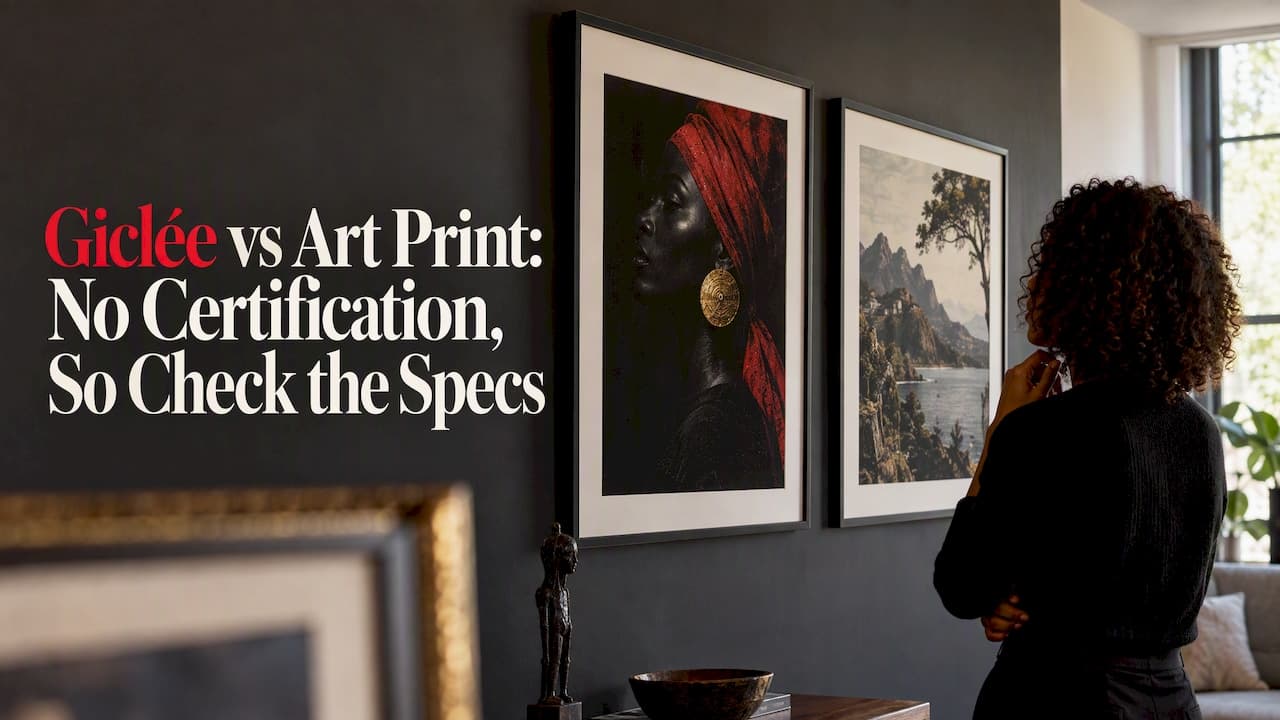
Giclée printing matters when you want the color accuracy and lifespan of a museum-grade reproduction: pigment inks, archival substrates, and a color-managed workflow genuinely outlast and outperform standard inkjet or photo-paper prints. If a piece is going on a wall for a season or sits in a budget frame away from sunlight, a standard art print does the job without the premium.
TL;DR:
- Giclée is not a regulated certification, so verify pigment ink, archival paper or canvas, and a calibrated ICC color profile rather than trusting the label.
- For detailed photography or illustration, choose cotton rag paper; canvas creates a painterly, frameless display but can soften fine lines and small text.
- Use UV filtering glazing and a mat or spacer for paper prints; display canvas without glass, and keep both away from sunlight.
- A giclée reproduces an existing artwork rather than creating an original; numbered editions, signatures, and provenance documentation carry more weight for collectors.
Table of Contents
- What giclée actually means: process, inks, and standards to look for
- Why 'art print' alone tells you almost nothing
- Key differences buyers will notice: inks, substrates, color, and permanence
- Canvas vs paper: display, texture, and framing tradeoffs
- Cost and value: what drives price and when giclée is worth it
- Buyer checklist: exact specs and documentation to request before you buy
- How The Prophets Artistry supports buyers: offerings and proof points
- Comparing the environmental footprint of giclée and other print methods
- Common misconceptions about giclée versus other art prints
- How print choice shapes perceived authenticity and value
- Author perspective: short guidance for collectors vs decorators
- How to buy prints and request commissions from The Prophets Artistry
- FAQ
- Sources
What giclée actually means: process, inks, and standards to look for
Giclée is a fine-art inkjet printing process built on three things: pigment-based inks, archival substrates like cotton rag paper or coated canvas, and a color-managed workflow that keeps the printed output true to the original file or artwork. The term comes from French printmaking and historically referred to prints made on large-format Iris inkjet printers using pigment inks, a practice that set the quality bar for digital fine-art reproduction, according to World of Printmaking.
Here is what qualifies, in practice:
- Pigment-based ink, not dye-based ink, run through a professional-grade inkjet printer.
- An archival substrate: cotton rag paper, art-grade canvas, or similarly rated fine-art paper.
- A calibrated color workflow using an ICC profile matched to the printer, ink, and paper combination.
No regulatory body certifies the word "giclée." It signals a quality approach rather than a legal standard, which means two prints labeled giclée can still differ in how long they hold their color, as World of Printmaking notes.
Why 'art print' alone tells you almost nothing
"Art print" is a catch-all. It can describe an offset lithograph run off a commercial press, a dye-based photo print from a drugstore kiosk, or a true giclée on archival cotton rag. The label says nothing about ink chemistry, paper quality, or how long the colors will hold.
Because the term carries no technical guarantee, the only reliable approach is reading the specifics on the product page rather than trusting the word "print" by itself. Before buying, confirm:
- The exact ink type (pigment-based versus dye-based).
- The substrate brand and material (cotton rag, canvas, or coated photo paper).
- Whether the piece is a limited edition, and if so, its numbering and provenance.
Every giclée is an art print, but not every art print is a giclée, and the gap between those two categories is where buyers get surprised.
Key differences buyers will notice: inks, substrates, color, and permanence
The practical differences show up in three places: how colors look fresh out of the box, how fine detail renders, and how the print ages.
Pigment inks sit on top of the paper fiber rather than soaking in, which makes them more resistant to water and UV fading than dye inks, which saturate the paper and tend to shift color faster under light exposure. Substrate matters just as much: cotton rag paper gives a matte, textured surface with a warm white point, coated photo paper gives sharper micro-detail and glossier color, and canvas trades some fine detail for a tactile, painterly surface.
Color fidelity also depends on the printer itself. Fine-art inkjet printers with more ink channels and well-built ICC profiles reproduce a wider color gamut and smoother gradients than consumer four-color printers, which is part of why giclée output tends to look closer to the original artwork.
- Pigment inks resist fading and moisture better than dye inks.
- Cotton rag paper offers texture and a warm tone; coated paper offers sharper detail; canvas offers a textured, frameless look.
- More ink channels and a tuned ICC profile produce more accurate color.
Top-tier pigment-ink and archival-paper combinations can reach long display-life ratings under standard indoor conditions, according to Wilhelm Imaging Research testing reported in PDN Magazine. That figure assumes a specific indoor light level, so a print displayed in direct sun or high humidity will not match it.
Canvas vs paper: display, texture, and framing tradeoffs
The right substrate depends on how the piece will be displayed and how much fine detail matters to you.
- Choose canvas when you want a textured, painterly look, plan to display it frameless on a stretcher bar, or want a bolder, more casual presentation. Fine linework and small text can lose some crispness on canvas.
- Choose paper, particularly cotton rag, when color accuracy and fine detail are the priority, such as with photography or intricate illustration work.
- Frame paper prints under glazing with a mat border rather than letting the print touch the glass directly, which protects the surface and prevents moisture buildup.
- Frame canvas on stretcher bars without glass, since the thicker material and varnish options already offer some surface protection.
Both substrates benefit from UV-filtering glazing when displayed near windows, and Library of Congress preservation guidance notes that light exposure causes permanent, cumulative damage to paper-based materials regardless of ink quality.
Cost and value: what drives price and when giclée is worth it
Price on a fine-art print is driven by a handful of concrete factors, not the word on the label.
- Size: larger prints use more substrate and ink and typically cost more.
- Substrate: cotton rag paper and art-grade canvas cost more than standard photo paper.
- Ink: pigment-based inks cost more to produce than dye-based inks.
- Provenance: limited editions, numbered runs, and artist-signed pieces add value beyond the physical materials.
- Finishing: mounting, varnishing, and framing add to the final price.
A lower-cost art print is a sensible choice for temporary decor, a rental space, or a gift where longevity is not the point. The giclée premium earns its keep when a piece is going into long-term display, when you care about color accuracy for photography or fine detail work, or when resale and collectibility matter, since documented materials and provenance support future value.
Buyer checklist: exact specs and documentation to request before you buy
Before you buy, ask the seller or read the listing for these specifics in order:
- The exact ink type: pigment-based, and ideally the ink family or brand.
- The substrate: paper or canvas brand and whether it is described as archival or acid-free.
- The color workflow: whether an ICC profile was used and whether a soft proof is available.
- The printer model or ink set, if listed, since this affects color gamut and permanence.
- Edition details: numbering, total run size, and any artist signature or certificate of provenance.
- Framing recommendations: UV-filtering glazing, acid-free conservation matting, and spacers to keep the print surface off the glass, per Library of Congress guidance.
Pro Tip: Ask for a soft-proof image or the printer and ink set name directly. A seller using true pigment inks and a calibrated workflow will usually have this information ready.
Red flags include a page that says "archival" with no ink or paper specs, no mention of edition size on a piece marketed as limited, or vague language about "museum quality" without naming materials.
How The Prophets Artistry supports buyers: offerings and proof points
We built our catalog around the same specifics this checklist asks for. We specialize in original pieces and prints across collections including photography, digital art, and themed cultural sets like the Rastafarian and Colombia collections.
- We focus on art that resonates culturally, allowing collectors to find pieces with meaningful narratives or identities.
- We provide a platform to support artists and their original and limited works.
- We offer custom commissions that cover a broad range of styles and cultural themes.
- Our Prints page and Size Guide are the places to start before reaching out about a commission.
Comparing the environmental footprint of giclée and other print methods
Pigment-ink printing generally uses less water and fewer harsh solvents than traditional offset lithography, which relies on chemical plate processing and large volumes of ink and cleaning fluid for commercial runs. Giclée production, done on demand rather than in bulk press runs, also tends to reduce overproduction waste since prints are typically made to order rather than stocked in large quantities.
Substrate choice affects the footprint too. Cotton rag paper is a renewable, biodegradable material, while coated photo papers often include synthetic resin layers that are harder to recycle. Canvas, usually a cotton or poly-cotton blend, has a longer physical lifespan than paper in rougher handling conditions, which can offset its production footprint if the piece stays in use for decades.
None of this makes any print method emissions-free. Ink production, paper milling, and shipping all carry a footprint regardless of process. The practical takeaway for a buyer who cares about this is to favor on-demand printing over bulk-run mass production and to ask whether a seller uses FSC-certified paper or recycled substrate options when available, since those details vary by vendor and are not guaranteed by the word "giclée" itself.
Common misconceptions about giclée versus other art prints

The biggest myth is that "giclée" automatically means archival, museum-grade, and guaranteed to last a century. The term describes a process, pigment ink on an archival substrate with color management, not a certified outcome, so quality still varies by printer, ink, and paper combination, as World of Printmaking explains.
A second misconception is that giclée is a type of artwork rather than a reproduction method. A giclée print is a reproduction of an original painting, photograph, or digital file. It is not itself an original piece, even when it is a limited, numbered edition.
A third myth is that any inkjet print can be marketed as giclée. Dye-based inkjet prints on standard photo paper are still common and are sometimes labeled loosely, which is exactly why checking ink type and substrate matters more than trusting the word on a listing.
Finally, some buyers assume paper prints are automatically more fragile than canvas. In practice, a well-framed cotton rag paper print under UV-filtering glazing can outlast a canvas print left exposed to direct sunlight, since framing conditions, not substrate alone, drive most real-world damage, according to Library of Congress preservation guidance.
How print choice shapes perceived authenticity and value
For culturally significant art, the printing method can shape how collectors read a piece's authenticity. A documented giclée, pigment ink, named substrate, numbered edition, signals that a seller treated the reproduction with the same care as the original work, which matters for pieces tied to a specific cultural narrative or artist identity.
A generic, undocumented "art print" carries less weight in that context, not because the image is less meaningful, but because there is no paper trail connecting it to the artist's intent or the original piece's materials. Provenance details, edition numbering, signatures, certificates, do more to establish a cultural art piece's value than the printing method alone, but a high-quality giclée process supports and protects that provenance by keeping the reproduction visually faithful over time.
For buyers choosing art meant to represent a cultural identity or personal story, the printing method becomes part of the object's integrity. A faithful, well-documented reproduction keeps the connection to the source material intact in a way a low-grade dye print cannot.

Author perspective: short guidance for collectors vs decorators
If you are a collector or buying for resale, giclée on cotton rag or canvas, properly documented, is worth the premium every time. If you are decorating a rental or buying a short-term gift, a standard print is a reasonable call. The real decision point is not the label, it is whether the piece needs to survive decades on your wall.
— Kylan
How to buy prints and request commissions from The Prophets Artistry
We make it simple to go from browsing to owning a piece built on documented materials and real provenance. Our Prints page covers available formats and themed collections, and our Size Guide helps you match a piece to your wall and framing plans before you commit.

- Browse the Prints collection to compare formats and themes.
- Check the Size Guide before ordering to plan framing and placement.
- Reach out to us about a custom commission if you want a piece built around your own story or cultural reference.
FAQ
Is it worth buying a giclee print?
A giclée print is worth the premium when you want long-term display quality or plan to treat the piece as a collectible, since pigment inks and archival substrates hold color far longer than standard dye-based prints. For short-term decor or a tight budget, a standard art print is a reasonable choice instead.
Do you put glass over a giclee print?
Yes, paper-based giclée prints should go under glazing with a mat border or spacer so the print surface never touches the glass directly. Library of Congress preservation guidance recommends UV-filtering glazing and acid-free matting to prevent light damage and moisture buildup.
Is it better to print a giclée print on canvas or paper?
Neither is universally better. Paper, especially cotton rag, gives sharper fine detail and more accurate color, which suits photography and intricate work, while canvas gives a textured, painterly look suited to bold, frameless display.
How much does a giclée print cost?
Price depends mainly on size, substrate, ink type, and whether the piece is a limited or signed edition, with larger, archival-substrate, pigment-ink prints costing more than small, standard dye prints. There is no single market-wide price, so it is best to check the specific collection or vendor listing, such as our Prints page, for current offerings.
Sources
- Fine Art Print Permanence – PDN Magazine – May 2016 (Wilhelm Imaging Research)
- Giclée printing: Process, materials & history explained | World of Printmaking
- Preservation guidelines for matting and framing | Library of Congress