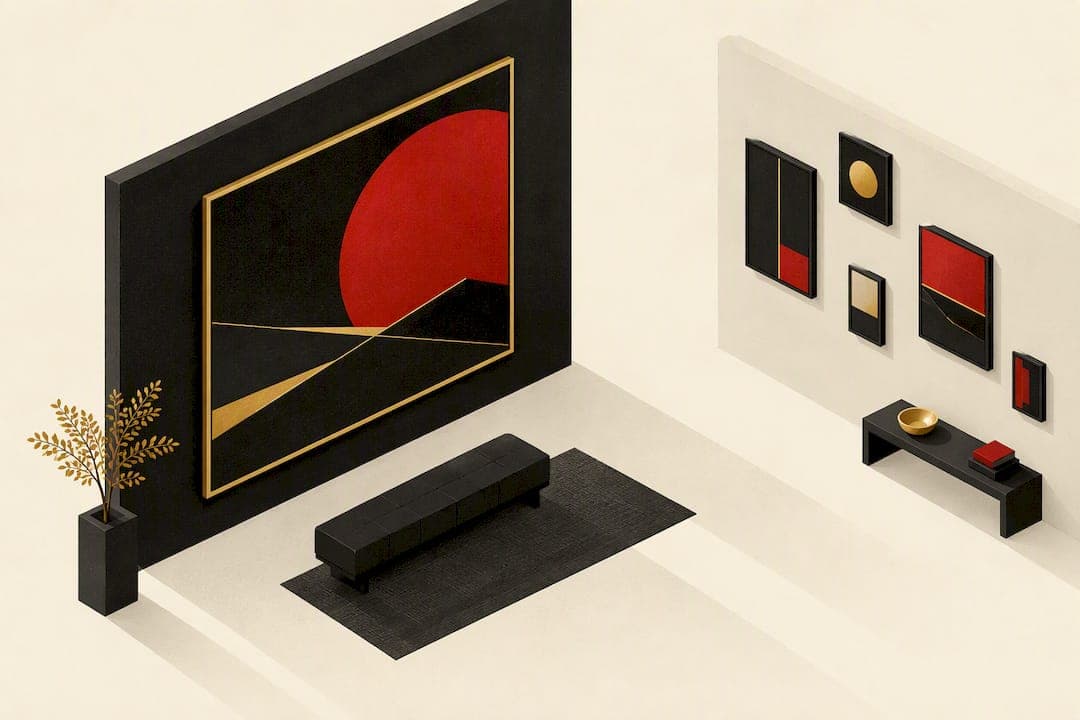
For most offices, one large statement print on the focal wall works better than several small pieces scattered around, and a curated trio or gallery grouping is the better call for narrower walls. Whether you want ready-made prints or a custom commission, The Prophets Artistry is a solid place to start browsing styles, sizes, and themed collections before you buy.
TL;DR:
- Match artwork to room function: muted, low contrast pieces suit focus areas, while bold, high contrast art energizes creative spaces and reception areas.
- Choose art spanning 60 to 75 percent of the furniture’s width, center it at eye level, and test paper templates on the wall for a day or two.
- Canvas reduces glare under office lighting; framed paper prints preserve fine detail but need glazing, while metal and acrylic finishes can reflect light.
- Budget separately for art, framing, mounting hardware, and lighting; framing can cost as much as the print, while commission prices depend on size and complexity.
Table of Contents
- Top styles and themes for office wall art
- How to choose print type and material
- Sizing and placement: quick math and layout templates
- Framing, hanging and lighting tips for office installations
- Styling ideas: single statement pieces, groupings, and color pairing
- Buying and commissioning with The Prophets Artistry
- Pricing overview and total cost considerations for office wall art purchases
- Benefits of choosing culturally rich and authentic art for office environments
- How to evaluate and select artwork that aligns with corporate identity and values
- Impact of artwork on office ambiance and employee productivity
- Author perspective: choosing art that lasts with you
- Order prints or request a custom commission
- FAQ
Top styles and themes for office wall art
The right style depends on what you want the room to do. A desk meant for deep focus calls for something different than a reception area meant to impress clients, so match the mood to the job before you shop.
- Motivational typography: short phrases or quotes that reinforce focus, works best near individual desks or small huddle spaces.
- Minimalist and abstract: clean shapes and muted palettes that calm visual noise, suited to open-plan offices with a lot of activity.
- Large-scale photography: landscapes, architecture, or portraiture that anchors a wall and reads well from a distance, good for lobbies and conference rooms.
- Cultural and heritage art: pieces that carry a specific story or identity, strong for brands that want their space to reflect real values rather than generic decor.
- Botanical and minimal line work: soft, low-contrast pieces that soften a hard-edged, tech-heavy environment.
- Modern colorful abstracts: bold color blocks that work in creative studios where energy matters more than quiet.
Before picking a direction, ask who sees the wall most often, whether your brand has colors or themes to respect, and whether the space needs to calm people down or wake them up.
How to choose print type and material
Material changes how a piece reads from across the room and how much upkeep it needs. Canvas has a soft, textured look with minimal glare, which makes it forgiving under office fluorescents. Framed giclée or fine art paper prints hold the sharpest detail and color depth, which matters for photography or intricate linework. Metal prints have a glossy, almost backlit quality that suits modern or tech-forward spaces but shows fingerprints and glare more easily. Acrylic face-mounted prints add depth and vibrancy, often used for statement photography pieces.
- Canvas: matte finish, warm texture, minimal glare, easiest to clean with a dry cloth.
- Framed paper or giclée: highest detail and color accuracy, needs glass or acrylic glazing for protection.
- Metal: glossy, modern, durable, but shows smudges and reflects light.
- Acrylic face-mount: deep, saturated color with a glass-like finish, best for photography.
For a one-of-a-kind wall, an original or limited-edition piece carries more weight than an open-run print, since no one else in the building will have the same thing on their wall. Open-run prints make more sense when you're outfitting multiple rooms or need to match a budget across several walls.
Pro Tip: Choose matte finishes for walls that face windows or overhead fluorescent lighting; gloss and metal finishes read best in rooms with controlled, directional lighting.
Sizing and placement: quick math and layout templates
Getting proportions wrong is the most common mistake in office decor, and it's an easy one to avoid with a few rules of thumb.
- Use the 60 to 75 percent rule. Art hung over a desk, credenza, or sofa should span the majority of that furniture's width, never the full width or a sliver in the middle.
- Hang at eye level. Center the piece around the standard gallery height that most people are comfortable looking at while standing.
- Space gallery walls evenly. Keep a few inches between framed pieces in a grouping so it reads as one composition instead of a cluster of mismatched frames.
- Mock it up before you commit. Tape paper cutouts in the exact dimensions to the wall and live with them for a day or two before ordering.
- Check your measurements against a size guide. Run your wall and furniture dimensions against the size guide before finalizing an order, since the right print size depends on both the wall and what sits beneath it.
Framing, hanging and lighting tips for office installations
A great print can still look wrong if it's hung poorly or lit badly. Choose hardware based on weight and wall type: drywall anchors handle most framed prints, French cleats distribute weight evenly for larger canvases, and wire hanging gives more flexibility for leveling than fixed D-rings.
Lighting matters just as much as the piece itself. Experts in office design recommend setting up ambient, task, and accent lighting before hanging decor, so the artwork never competes with harsh glare or visual clutter once it's up. Position accent lighting at an angle rather than straight on to avoid washout, and consider anti-reflective glazing for anything near a window.
- Heavy canvas or framed pieces: use French cleats or two anchor points rated for the frame's weight.
- Lightweight prints: wire hanging on a single hook is usually enough.
- Near windows or overhead lights: anti-reflective glazing cuts glare significantly.
Pro Tip: Route or clip any visible cords before hanging art nearby, since a tangle of cables near a framed piece pulls attention away from the focal point.
Styling ideas: single statement pieces, groupings, and color pairing
A single oversized piece works best in smaller offices or individual rooms where you want one clear focal point without competing elements. A triptych, three related pieces hung as a set, suits wider walls behind a desk or in a conference room. Corridor galleries, a sequence of smaller framed works spaced evenly down a hallway, give repeat visitors something new to notice each time they walk through.
For color, decide early whether you want contrast or harmony. A bold, high-contrast piece against a neutral wall becomes the room's anchor. A tonal piece that echoes your existing palette blends in and supports a calmer, more cohesive look.
- Measure the wall and the furniture beneath it before shopping.
- Mock up the layout with paper or tape to confirm scale.
- Photograph the mockup in your actual lighting to check for glare or color clash.
Buying and commissioning with The Prophets Artistry
Once you know the style, size, and material you want, the next step is finding or ordering the piece itself. We carry ready-made prints, originals, a dedicated photography collection, and themed sets including the Colombia Collection and the Rastafarian Collection for buyers seeking a specific cultural narrative.
- Browse by collection to find a style and theme that fits your space.
- Request a custom commission by sending reference images, your desired dimensions, and your timeline.
- Check product pages for mockups and sizing notes before you order.
Every product page includes imagery and sizing information so you can preview scale before committing, and the size guide walks through measurement rules for different wall and furniture relationships. Commission requests work best when you share inspiration images up front along with your deadline, since that lets the piece get sized and planned correctly from the start.
Pricing overview and total cost considerations for office wall art purchases
Office art spending usually breaks into three categories: ready-made prints, custom commissions, and framing or installation extras. Open-run prints tend to be the most budget-friendly entry point, since the same image can be produced at multiple sizes without the cost of an original piece. Limited editions and originals cost more because you're paying for scarcity and, often, a direct relationship with the artist's process.

Commissioned work adds planning time and back-and-forth communication into the cost, which is part of why it's priced differently from a catalog print. Framing is a separate line item worth budgeting for separately, since a frame built to protect and display a piece properly in an office setting, with anti-glare glazing where needed, often costs as much as the print itself.
For current pricing on any specific piece or collection, our prints and originals pages list availability by item, and commission pricing is quoted individually based on size and complexity. Budgeting for a full office means accounting for the piece, the frame, mounting hardware, and any lighting adjustments needed to display it well, rather than just the sticker price of the print.
Benefits of choosing culturally rich and authentic art for office environments
Generic stock art fills a wall but rarely says anything about the people who work in the room. Culturally rich pieces, whether tied to a specific heritage, place, or artistic tradition, give an office a point of view instead of blank visual filler.
For businesses, this matters beyond aesthetics. Clients and employees notice when a space reflects genuine identity rather than whatever was cheapest to order in bulk. Our themed collections, including the Colombia Collection and Rastafarian Collection, exist specifically for buyers who want their walls to carry a real cultural narrative rather than an anonymous pattern.
For individuals decorating a personal office or home workspace, authentic art tends to hold its appeal longer than trend-driven decor, because it's tied to something meaningful rather than whatever was popular the year it was purchased. A piece that reflects a real place, tradition, or story keeps giving you something to notice, long after a purely decorative print has faded into the background.
How to evaluate and select artwork that aligns with corporate identity and values
Start by writing down three or four words that describe how you want the space to feel and what the brand stands for. Bold and energetic calls for different art than calm and trustworthy, and that distinction should guide every piece you choose from here forward.
Next, check color against your existing brand palette. Art doesn't need to match your logo exactly, but jarring color clashes between the walls and the brand's visual identity undercut the message you're trying to send to clients and employees alike.
Finally, consider subject matter. A law firm and a creative studio shouldn't necessarily choose the same style, even if they like the same artist. Cultural and themed collections work well here because they let a business signal specific values, like heritage, authenticity, or craftsmanship, rather than defaulting to safe, forgettable abstractions that say nothing about who occupies the space.
Impact of artwork on office ambiance and employee productivity
The right art changes how a room feels to work in. A wall full of generic motivational posters often reads as filler, while a well-chosen statement piece or themed collection gives people something genuine to look at during a mental break.
Color and subject matter set the tone of a room before anyone says a word. Calming, tonal pieces suit spaces meant for focus work, while bold, high-contrast art energizes creative or collaborative areas. Matching the art to the function of the room, rather than picking whatever's trending, makes the choice work harder for the people actually using the space every day.
Beyond mood, art gives visitors and employees something to talk about, which matters more than it might seem in shared spaces where small moments of connection build culture. A reception area with a striking, authentic piece sets a different first impression than a hallway with stock photography nobody chose on purpose.

Author perspective: choosing art that lasts with you
Trend-driven decor dates fast. Art tied to a real story, a place, a tradition, a personal connection, tends to hold up because the reason you chose it doesn't expire with the season. When you're furnishing a space you'll look at every day, pick the piece that means something over the one that simply matches the couch.
— Kylan
Order prints or request a custom commission
Once you've settled on a style, size, and budget, converting that decision into a finished wall is straightforward. Browse our prints collection, cross-check your wall dimensions against the size guide, and check out directly from the product page you choose.

- For a ready-made piece: pick a print, confirm sizing, and order.
- For a commission: send inspiration images, your preferred dimensions, and your deadline so the piece gets planned correctly from the start.
- For originals: browse the originals collection for one-of-a-kind statement pieces.
Shipping and returns details are available on each product page, so you can order with a clear picture of what to expect before the piece arrives.
FAQ
What size should office wall art be?
Our size guide walks through measurement examples for different wall and furniture combinations.
What's the difference between canvas and framed prints?
Canvas has a matte, textured finish with minimal glare, which works well under office lighting, while framed paper or giclée prints hold sharper detail and color depth but need glazing to protect them. The right choice depends on whether you prioritize a soft look or maximum image clarity.
How long does a custom art commission take?
Commission timelines vary by piece complexity and the artist's current workload, so it's best to share your deadline up front when requesting a commission. Including reference images and your desired dimensions at the start helps keep the process on track.
How high should I hang art in an office?
Center most pieces around the standard gallery height from the floor, which is the typical eye-level height used in galleries and offices alike. For gallery walls, keep that same center height for the overall grouping rather than each individual piece.
Does office art actually affect productivity?
Art that matches a room's function, calming pieces for focus areas and bolder pieces for creative spaces, tends to support the mood a workspace is going for, while mismatched or generic decor can feel like visual noise. Choosing pieces with real meaning behind them also gives people something more engaging to look at during a break.